This page lists a selection of profile feature articles and interviews about my research.
Introducing Anthropology, 2021, interviewed by Laura Pountney & Tomislav Marić
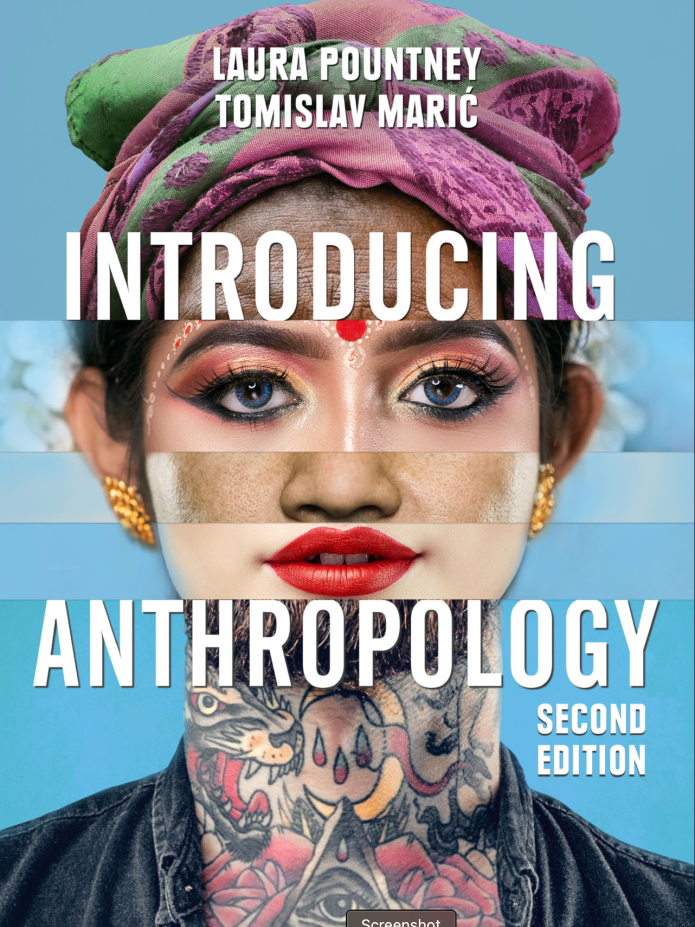
“… in traditional ethnographic fieldwork, researchers often have the privilege and time to build rapport and even genuine friendships with informants over time. This will mean that, at times, there will be sensitive or contentious information and situations that I am privy to, under conditions where we may be ‘off duty’ or ‘off stage’ as a friend. Good, ethical ethnographers will take the time to consider these ambiguous boundaries and not partake in research or produce outputs that may do their informants harm.
In the past, I have chosen to forgo some very rich and exciting data in order not to jeopardize the trust and friendship I share with some informants, which are simultaneously research, political and humane decisions that require quiet consideration. In digital spaces where rapport is built through online relationships, networks and reputation, presence and footprints, or content and contributions, these decisions take a little more effort and care, especially as it can feel more convenient or easy to dismiss or displease someone when interactions are mediated through a screen.”
Intercom 44(1), January 2021 (in Portuguese), interviewed by Issaaf Karhawi
“Digital influencers are a product of popular culture. This means we can also read them as a popular cultural text insofar as they serve many purposes. Sometimes they represent reality, sometimes they shape reality, sometimes they reflect reality, and there are many types of influencers. It’s difficult to say which will be the most popular, which will be the most well-received, because both the industry and the genre are very diverse. Similarly, the audiences are also diverse.
Specifically regarding the pandemic, it’s possible to say that people around the world have been affected in very different ways. I have been following, for example, luxury fashion influencers who seem untouched by the pandemic and, unsurprisingly, some of their followers in privileged positions, in wealthy countries, also seem untouched by the pandemic. Therefore, the production of their content continues. They continue to participate in luxury virtual fashion shows and events, they continue to consume exclusive fashion items, and nothing has stopped because, for the audiences and for these content creators, business continues as normal.
For other influencers, those outside traditional media and belonging to other social classes, it was necessary to exercise greater discernment and use new tactics in content production. This is because if they demonstrated a certain degree of irresponsibility by continuing to go out on holidays, failing to wear masks, or focusing only on the best angle of the day’s meal, they risked alienating their followers, many of whom were facing financial, emotional, and physical difficulties due to the pandemic.”
Moment 7(2), 12 December 2020, interviewed by Asli Telli Aydemir
“My primary informants are influencers and people who work in the influencer industry. My larger research has many tentacles, looking at weddings and the commodification of them, mixed race children, social media use, meme ecologies, but all in all, most of these are mediated by technology. So when I want to communicate my research and my outputs, my informants are always welcome to read the journal articles or books that I write. But I feel it is my duty and responsibility to also consolidate the research into a format that is palatable and accessible for my informants to read. And this I have various reasons for:
The first is the ethos of open access – and it’s not just access to the actual format – but open access as in how scholars can make research understandable as part of public scholarship. This would mean reframing the key points of a paper or theory to make it applicable to the layperson on the street who would otherwise not really care about academia.
The second reason is that most of my informants generally benefit from the visibility of their work. One of the pay-offs for them is this catharsis of being with a researcher, having your stories documented as history, and of course, to a certain extent, a bit of publicity for them when I present the work in conferences and papers.
The third reason for curating my research is that it helps me build up my social capital; when I interview or want to interview a new informant, sending them my CV and a list of my publications probably means absolutely nothing to them. They probably don’t care about that. But if they can see from, say, my Instagram portfolio or my blog that I have been studying this phenomena for many years, and if many case studies are open to them to look at, the invitation to be interviewed and to participate in research seems more appealing, and they might be more likely to respond to me. In brief, my blog underscores a variety of ethos.”
Networking Knowledge 13(1), 25 October 2020, interviewed by Kate Stuart & Eoin Murray
“Also, since there are probably going to be junior scholars reading this interview, I think a word of caution is due: Everyone always says if you enjoy your work it’s not going to feel like work. Now that is a lie! It’s just going to feel like everything is work and we have to be extra careful about policing our work/life boundaries and ensuring that our wellbeing is taken care of. In my case, one of the gripes that I always put out to the universe is that when I’m not working and using social media recreationally, I always feel compelled to still have my work brain on in the background, or worse, at times feel pressured by others to be working all the time.
To combat this, I decided to set up boundaries and guidelines for myself. I’ve got separate accounts for secretly closeted embarrassing fandoms, my various interests, and my work and professional front. I also set specific times where I am online for work versus being online for leisure. […] I want to be clear that as much as I love my research, academia is my job and being an academic is not my master status or my entire identity. It is important to preserve and grow these other facets of oneself.”
CaMP Anthropology, 13 May 2019, interviewed by Mary-Caitlyn Valentinsson
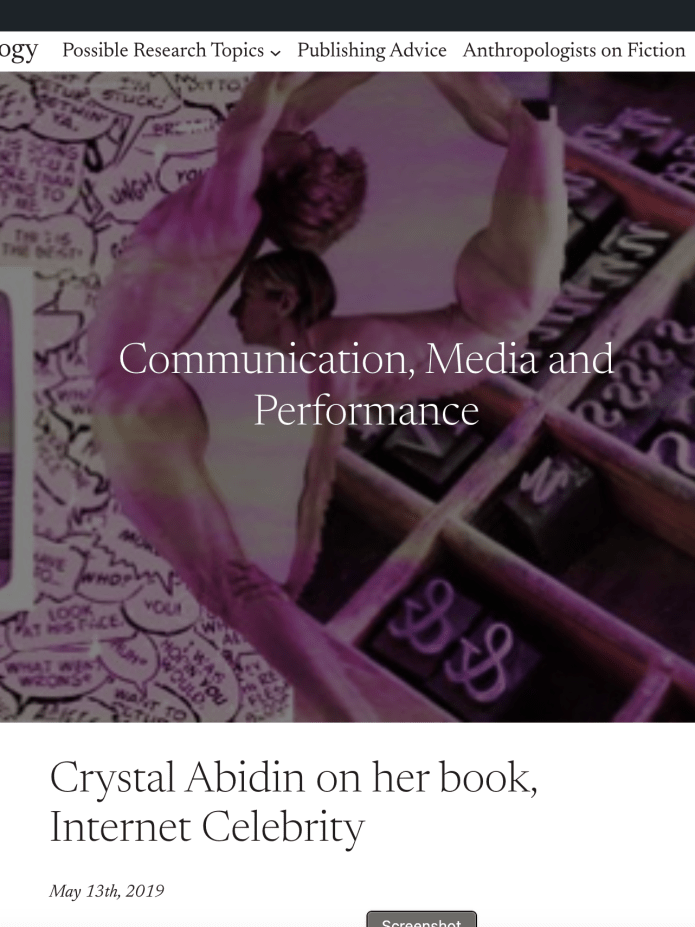
“This is one of the things I struggled with in my earlier work in my doctoral studies, that if we were bounded by a discipline in terms of where we looked for journals or for books, we would miss out on a lot of the good debate developing in other industries and developing in other disciplines. So that was one thing I struggled with and one thing I needed to overcome. I was explicit throughout the whole book that I work primarily as an anthropologist and as an ethnographer but my literature review was more encompassing and generous across the disciplines. […]
I also made specific decisions over which of my locational or cultural fieldsites to showcase – where possible and where the arguments could still be communicated well, I substituted many Anglo- and Euro-centric examples with ones from the Global South, in line with my research and personal ethic to promote visibility and representation of equally interesting phenomena happening elsewhere in the world that is often lost in discourses propagated by the popular media.”
The Jakarta Post, 8 April 2019, interviewed by Suci Haryati
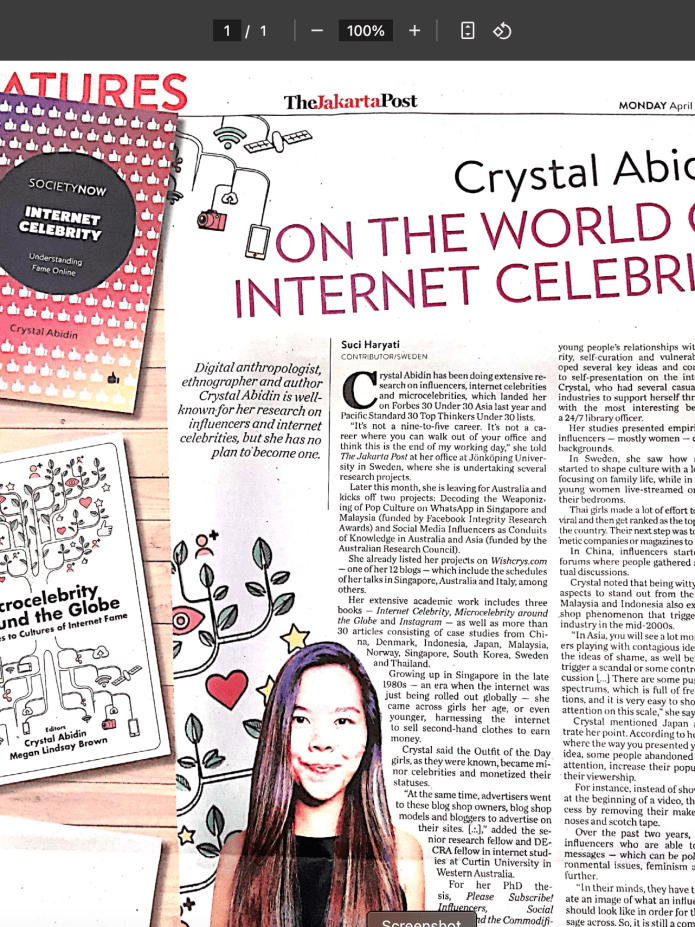
“Growing up in Singapore in the late 1980s – an era when the internet was just being rolled out globally – she came across girls her age, or even younger, harnessing the internet to sell second-hand clothes to earn money. Crystal said the Outfit of the Day girls, as they were known, became minor celebrities and monetized their statuses. […]
In Asia, you will see a lot more of these influencers playing with contagious ideas and playing with ideas of shame, as well being more willing to trigger a scandal or some controversy to start a discussion […] There are some push-and-pull in these spectrums, which is full of freedom and constrictions, and it is very easy to shock people or to gain attention on this scale.”
Pacific Standard, 2 March 2016, interviewed by Natalya Savka
“Anthropologist Crystal Abidin is re-defining how we view Internet-famous people—or “influencers,” as she calls them. Many people assume that the people whom she studies are “just being pretty and doing frivolous things on the Internet,” Abidin says. That’s because most of the influencers in question happen to be young women who often blog about fashion and make-up. […]
Abidin chose to research Internet influencers for her Ph.D. at the University of Western Australia because she admires their ability to create intimacy with followers. “I’m so intrigued by how you can get so attached to someone through a screen,” she says. Abidin narrowed her study’s scope to Singapore partly because she grew up there and has followed its influencer industry since 2010.”
Journalisten, 19 December 2015 (in Norwegian), interviewed by Aslaug Olette Klausen
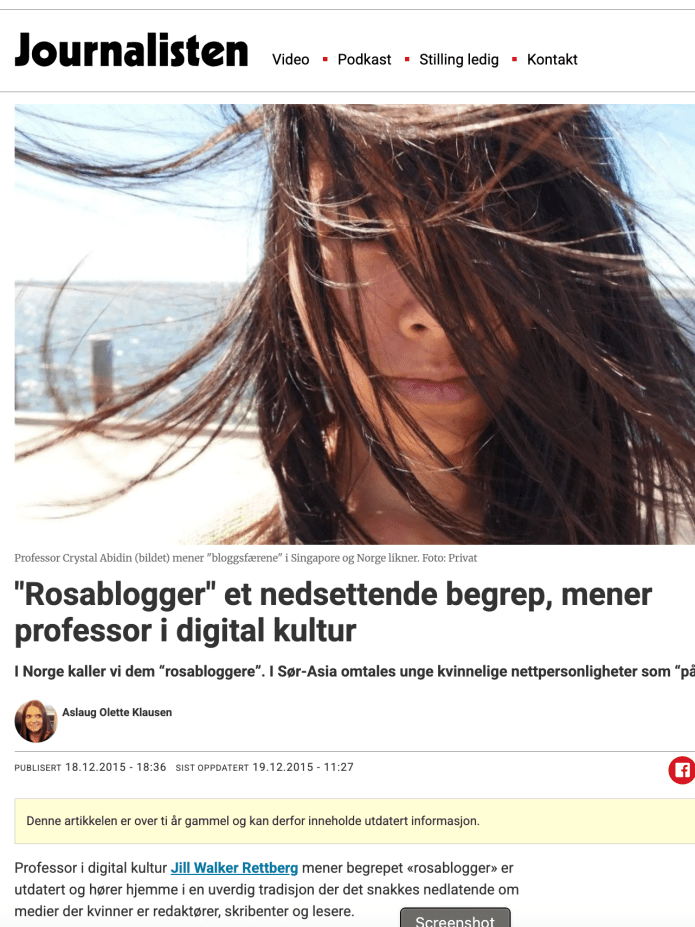
“… I use “physical” and “digital” spaces, rather than online/offline, or on/off the web. This is because influencers in Singapore are unique in connecting with their audiences on social media, and in face-to-face meetings. All to create a feedback loop of commercial intimacy. I also write about how the intimate relationship between the influencer and the follower is commercial, interactive, mutual and open.
I think that influencers and their digital property have high impact and influence in East Asia. They are experts at capturing the attention of the audience with disposable income aged 15–35. Even more important is that they play on the gendered intimacy of being female influencers with female followers. They create feminine ideals that they become role models for, and followers may emulate them through purchasing the products and services that they promote.”
Digital Ethnography Research Centre, June 2015, interviewed by DERC
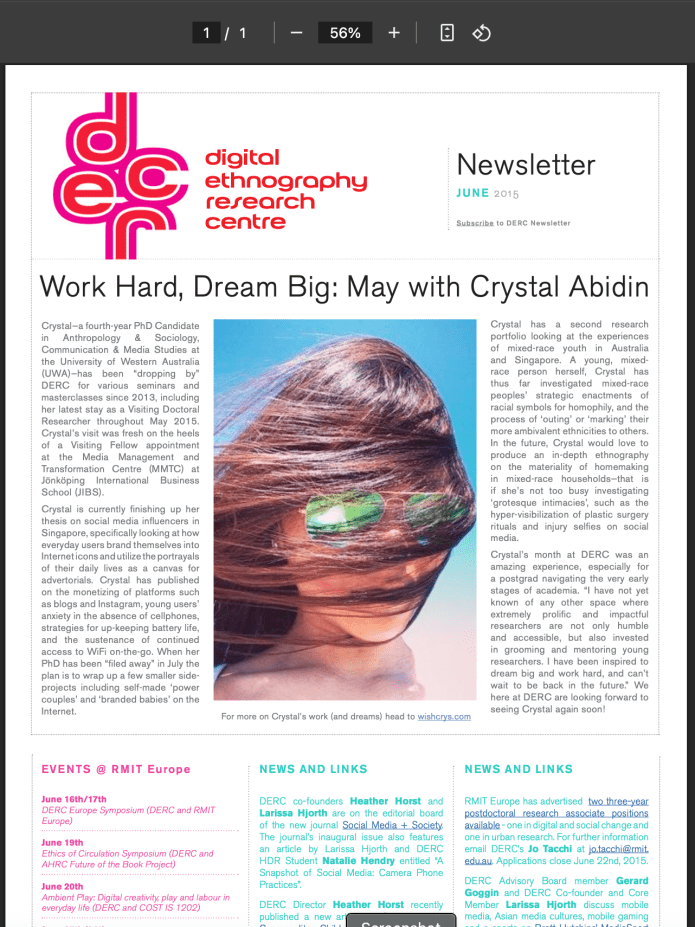
“Crystal is currently finishing up her thesis on social media influencers in Singapore, specifically looking at how everyday users brand themselves into Internet icons and utilize the portrayals of their daily lives as a canvas for advertorials. Crystal has published on the monetizing of platforms such as blogs and Instagram, young users’ anxiety in the absence of cellphones, strategies for up-keeping battery life, and the sustenance of continued access to WiFi on-the-go.
Crystal has a second research portfolio looking at the experiences of mixed-race youth in Australia and Singapore. A young, mixed race person herself, Crystal has thus far investigated mixed-race peoples’ strategic enactments of racial symbols for homophily, and the process of ‘outing’ or ‘marking’ their more ambivalent ethnicities to others. In the future, Crystal would love to produce an in-depth ethnography on the materiality of homemaking in mixed-race households—that is if she’s not too busy investigating ‘grotesque intimacies’, such as the hyper-visibilization of plastic surgery rituals and injury selfies on social media.”
This page was last updated on 12 April 2026.
 WISHCRYS